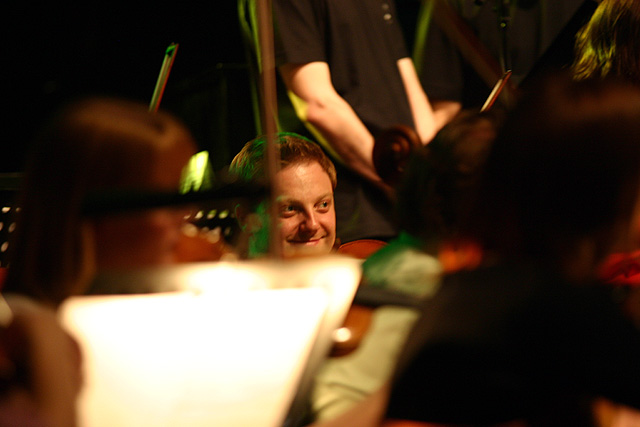
I was lucky enough to get a ticket to Thursday's dress rehearsal of Kaija Saariaho's new opera Adriana Mater at the Finnish National Opera; the official première was last night. Having followed Saariaho's music for the last thirteen years, and having attended three performances of her previous opera L'amour de loin, there was really no question as to whether I was going to like this piece or not. Saariaho's music is captivating, agonisingly beautiful, at times visceral and violent, and Adriana Mater is no exception. For those with Finnish, here is Helsingin Sanomat's review.
The intricacies and subtleties of the music and staging require too much thought to post about right now, but perhaps I'll return to this subject at a later opportunity. I'm compelled to post regarding a conversation I had last night with K, who had just come from the première. K is himself a formidable and experienced musician, whose opinions I don't take lightly. For me, this fact makes his assessment of the opera all the more alarming. I described the opera as "häkellyttävä" (astounding, astonishing), to which K replied that that would certainly be an appropriate term. After I said that I had expected nothing less from Saariaho, it turned out that his comment was meant sarcastically. "How so?" I asked. "Well, for a start, it's badly written, badly orchestrated, and the orchestra doesn't get to play any melodies," he replied. For a moment, these comments rendered me speechless. Of course, people can disagree on the merits of any given piece of music, and I love a good argument as much as anyone, but in this instance, K's argumentation is, in my opinion, so fundamentally flawed that it has driven me to afford it deeper consideration.
Admittedly, I haven't examined the score very closely but, having a knowledge Saariaho's previous music, I think it's fair to say that melody is not and has never been a defining feature of her aesthetic. According to K, the players find the piece "boring". Do they feel cheated because they don't get to play grand melodies, I wonder. Perhaps more than concert music, isn't opera all about the audience, about the experience of listening to an orchestra while being visually stimulated by what is happening on the stage? Boring or not for the musicians, Adriana Mater is a highly successful piece of music theatre precisely because it engages the audience, which for me is a more relevant criterion by which to judge the music than whether the musicians enjoy playing it or not.
When I asked K to give an example of how the piece is "badly orchestrated", he mentioned a section in the clarinet part which requires a high c#4. "How can a player be expected to produce this note night after night?" he asked. A quick look on Google reveals fingering charts for all the notes up to d4. Agreed, these pitches are at the upper reaches of the clarinet's altissimo register, but you can't call something badly written just because it's difficult. If you claim to play the clarinet, you play the whole clarinet, not just the easy bits.
Performers are notorious for taking the path of least resistance when it comes to new music. Too often one hears performers claim that certain techniques are "impossible", when what they mean is that they are difficult, outside the boundaries of standard technique (agreed), the implication being that these techniques actually involve some practice. At a new music workshop a few years ago, the cellist who played my piece came up to me later in the evening and told me that I shouldn't write microtones because they're very hard to produce. Well, cry me a river! I replied by explaining that, as a string player, I know exactly how difficult (or not) it is to produce microtones on a string instrument. To give a more extreme example: Brian Ferneyhough's music is "difficult", but if you decide to perform it you then take on the responsibility of learning it properly. That this is a revelation to some professional musicians is surprising to say the least.
This whole conversation – and writing this post – reminds me of the exchange between amputee pianist Paul Wittgenstein and Maurice Ravel regarding the latter's Piano Concerto for the Left Hand (commissioned by the former). Wittgenstein wanted to rearrange some aspects of the piano part claiming famously that "performers must not be slaves!" Ravel's answer was simple and to the point: "Performers are slaves." The day composers allow performers' whims and, dare I say, in some cases, laziness to dictate what can and can't be done with their instruments will be the day all progress in the field of musical expression grinds to a halt.
Sunday, February 24, 2008


Thursday, February 14, 2008
Filth and Wisdom
Just when you thought it was safe to go back into the cinema, Madonna goes and does it again. Not as actor (for which we may be eternally thankful) but as director (groan). Like most people who haven't been at the Berlin Film Festival this week, I haven't seen this film, so I can't give any first-hand reaction to it. Judging, however, by the reviews, including this one by Peter Bradshaw in today's Guardian, I seriously wonder what it's chances are of ever being put on general release.
Ms Ciccone / Mrs Ritchie is a perplexing, vexing figure. Her music is bland in the extreme, yet it is touted, particularly to young gay men, as if it were the pinnacle of expressive art (note to self: try not to sound too much like Peter Giles...) Her use of Abba's music in a recent single was, in my opinion, utterly unforgivable and serves merely to underline the vacuousness and sheer lack of any originality that characterises Madonna's career. Her acting career was abysmal (Swept Away and The Next Best Thing rank alongside Crossroads as possibly some of the worst films I've ever seen). And so forth and so forth...
Now we have her directorial debut bearing the vaguely Austenesque title Filth and Wisdom. Peter Bradshaw's one-star review certainly doesn't spare the wrath. But really, in a related article, Madonna states: "I have always been inspired by the films of Goddard [sic], Visconti, Passolini [sic] and Fellini and hope that I may one day make something that comes close to their genius." The audacity of this statement leaves me speechless.
I'm pleased to note that the Guardian refrains from referring to Madonna as the Queen of Pop - I mean, who ever said she was the Queen of Pop? I could name a whole list of people manifestly more deserving of that title, but whose careers have suffered by virtue of actually being able to sing without the intervention of modern audio technology [Peter Giles alert!!!] - and settles for the far more apt Queen of Reinvention. I'm also indebted to Julie Burchill for many laughs in her numerous columns on the Immaterial Girl herself (two good examples of which can be found here and here). All I can say is that if the film is ever released in Finland, I will go and watch it and attempt to post an objective review here, but until then, let's not hold our collective breath...
Ms Ciccone / Mrs Ritchie is a perplexing, vexing figure. Her music is bland in the extreme, yet it is touted, particularly to young gay men, as if it were the pinnacle of expressive art (note to self: try not to sound too much like Peter Giles...) Her use of Abba's music in a recent single was, in my opinion, utterly unforgivable and serves merely to underline the vacuousness and sheer lack of any originality that characterises Madonna's career. Her acting career was abysmal (Swept Away and The Next Best Thing rank alongside Crossroads as possibly some of the worst films I've ever seen). And so forth and so forth...
Now we have her directorial debut bearing the vaguely Austenesque title Filth and Wisdom. Peter Bradshaw's one-star review certainly doesn't spare the wrath. But really, in a related article, Madonna states: "I have always been inspired by the films of Goddard [sic], Visconti, Passolini [sic] and Fellini and hope that I may one day make something that comes close to their genius." The audacity of this statement leaves me speechless.
I'm pleased to note that the Guardian refrains from referring to Madonna as the Queen of Pop - I mean, who ever said she was the Queen of Pop? I could name a whole list of people manifestly more deserving of that title, but whose careers have suffered by virtue of actually being able to sing without the intervention of modern audio technology [Peter Giles alert!!!] - and settles for the far more apt Queen of Reinvention. I'm also indebted to Julie Burchill for many laughs in her numerous columns on the Immaterial Girl herself (two good examples of which can be found here and here). All I can say is that if the film is ever released in Finland, I will go and watch it and attempt to post an objective review here, but until then, let's not hold our collective breath...
Prejudice and Pride
Reading through Peter Giles' interesting history of the fall and rise of the counter tenor (entitled – what else? – The Counter Tenor) I was struck and a little disappointed by his attitudes to any music other than 'classical'. (Here I use inverted commas just as he does to refer to any other form of music). Had the following opinions been published in, say, the 1920s, one could almost understand them, though his level of animosity towards musical development would still have seemed rather alien to our modern sensibilities. The fact that these opinions were published in 1982 makes one wonder why his publisher didn't suggest he dilute his vitriol. Here is a typical example:
And...
The irony that these comments and countless others like them appear in a chapter entitled 'Prejudice and the Status Quo' will surely be lost on nobody. Neither, indeed, is the irony of two lengthy citations, both written in the 12th century, in the following chapter on the development of organum singing and the rise of the Paris Notre Dame School. It would appear that Giles in fact part of greater, not to mention highly legitimate, tradition of moaning about the development of music, a tradition stretching back a thousand years.
As Giles points out, "John of Salisbury was also worried by much of what he heard":
The whole world of serious music is itself the subject of incredible prejudice. It is ignored good-naturedly, or scornfully dismissed as irrelevant by a now sizeable and growing proportion of the general public, who know nothing of any tradition before Elvis Presley and care less. (Giles 1982:3)
And...
So we have a fascinating situation: on the one hand a tradition legitimate and honoured, successor to the Romantic, Classical and Baroque, going back to Renaissance and Medieval times, but hidebound in many matters. Next to it, another tradition, recent and clearly illegitimate, artificial, of mammon, in many ways barbaric, all too prey to the whim of the moment and the wave of the manipulator's chequebook; but at least utterly free to go where it will within its limited abilities and 'cultural' boundaries. The first is the undoubted arena for, surely, the ultimate in vocal and instrumental technique, for mankind's most profound musical experiences and statements. The second, for the most part and with the exception of the art form 'jazz' and certain musicianly groups like 'Sky', comprises ephemera perhaps more of interest to the sociologist than the true artist musician. (Giles 1982:4-5)
The irony that these comments and countless others like them appear in a chapter entitled 'Prejudice and the Status Quo' will surely be lost on nobody. Neither, indeed, is the irony of two lengthy citations, both written in the 12th century, in the following chapter on the development of organum singing and the rise of the Paris Notre Dame School. It would appear that Giles in fact part of greater, not to mention highly legitimate, tradition of moaning about the development of music, a tradition stretching back a thousand years.
Whence hath the Church so many organs and musicall instruments? To what purpose, I pray you, is that terrible blowing of belloes, expressing rather the crashes of thunder than the sweetnesse of the voyce? To what purpose serves that contraction and inflection of the voyce? [...] Sometimes, which is a shame so to speake, it is enforced into a horse's neighing: sometimes the masculine vigour being laid aside it is sharpened with the shrillnesse of a woman's voyce: now and then it is writhed and retorted into a certain artificial circumvolution. (Aelred of Rievaulx, Speculum Charitatis, 1123)
As Giles points out, "John of Salisbury was also worried by much of what he heard":
The very service of the Church is defiled, in that before the face of the Lord, in the very sanctuary of sanctuaries, they, showing off as it were, strive with effeminate dalliance of wanton tones and musical phrasing to astound, enervate, and dwarf simple souls. [...] When this type of music is carried to the extreme it is more likely to stir lascivious sensations in the loins than devotion in the heart. (Policraticus, trans. John of Salisbury, 12th century).And he wasn't even talking about Elvis Presley...
Wednesday, January 23, 2008
Finnish History II
Further to my post about the conflicting interpretations of Finnish history, here is the letter from the ambassador (which I have abridged) sent in response to Alex Ross's column on Sibelius:
[However, the handing over of Finnish Jews to the Nazis is also well documented.]
Pekka Lintu, Ambassador of Finland, Washington, D.C. (printed in the New Yorker, July 23 2007)
Other than in the early 1930s, when Fascist elements unsuccessfully challenged our democratic system, Fascism has never played a significant role in Finnish politics. There were never any "Nazi-style race laws" in force in Finland, and the Finnish government's wartime policy of resisting German attempts to inspire anti-Jewish actions in Finland has been publicly appreciated by our Jewish communities.
[However, the handing over of Finnish Jews to the Nazis is also well documented.]
For Finland, the Continuation War of 1941-44, as it is called in our history, has its roots in the Winter War[...] the annexation of the Baltic countries, in the summer of 1940, demonstrated the expansive nature of the Soviet policies and left the area vulnerable to further aggression. The Continuation War, then, was a defensive struggle for my country, politically separate from the war of the great powers.
Pekka Lintu, Ambassador of Finland, Washington, D.C. (printed in the New Yorker, July 23 2007)
Saturday, January 19, 2008
Our man in Northfield
I was very pleased to note this afternoon that my dear friend in Northfield MN, Alex Freeman, has launched his own website. The site contains everything you'll ever need to know about Alex who, as a composer, singer-songwriter, tenor, bass trombonist and, latterly, assistant professor of music at Carleton College, is without a doubt one of the most multitalented people I am honoured in knowing.
Much as, on a recent visit to London, I tortured myself by reading the concert listings at the South Bank, leaving myself hopelessly salivating over all the wonderful concerts I wouldn't be able to attend, Alex's site features tantalising news of upcoming events and performances of his work. If you happen to be in Northfield on February 8th you're in for a treat. For anyone outside Finland, the performance of Magnolia for kantele, a Finnish harp-like instrument, promises to be quite an event.
But for those of us who can't make it, hope comes in the form of mp3 downloads of some of Alex's recent work, including three of the Four Songs of Hellaakoski performed by the HOL choir, a group that has championed music by Alex and Canadian composer Matthew Whittall, under the direction of Esko Kallio. You can also listen to (though not download) a number of other pieces, including O Magnum Mysterium, a choral work that I had the pleasure of singing in December. Though the loud sneeze during the quiet section is annoying, the performance is great. This music makes me weep.
Much as, on a recent visit to London, I tortured myself by reading the concert listings at the South Bank, leaving myself hopelessly salivating over all the wonderful concerts I wouldn't be able to attend, Alex's site features tantalising news of upcoming events and performances of his work. If you happen to be in Northfield on February 8th you're in for a treat. For anyone outside Finland, the performance of Magnolia for kantele, a Finnish harp-like instrument, promises to be quite an event.
But for those of us who can't make it, hope comes in the form of mp3 downloads of some of Alex's recent work, including three of the Four Songs of Hellaakoski performed by the HOL choir, a group that has championed music by Alex and Canadian composer Matthew Whittall, under the direction of Esko Kallio. You can also listen to (though not download) a number of other pieces, including O Magnum Mysterium, a choral work that I had the pleasure of singing in December. Though the loud sneeze during the quiet section is annoying, the performance is great. This music makes me weep.
Thursday, January 10, 2008
Crash Course in Finnish History
Given that this blog claims to be a "review" of sorts, it seems fitting to begin 2008 with a review of a film I saw this evening, namely the latest film by Finnish director Lauri Törhönen, Raja 1918 ("Border 1918").
 The film is set during the Finnish Civil War of 1918, a year after Finland had declared independence from Russia. In a nutshell, the war was between the "Whites" (the national guard) and the "Reds" (the Bolsheviks). The film follows the young Captain Carl von Munck who is sent to the newly established border to make sure that undesirable elements (Russians, Jews, Bolsheviks) are kept out of Finland. Of course, ther's also a romantic subplot between von Munck and the local school teacher Maaria Lintu, who, it transpires, is hiding her Bolshevik fiancé from the firing squads. [The "tragedy" motif in the soundtrack was presumably a quote from Im Treibhaus, the third movement of Wagner's Wesendonk-lieder and a study for the beginning of Act III of Tristan and Isolde.]
Anyway, back to the film! I was most impressed by the script. In less than a hundred years spoken Finnish has changed radically and this script preserves a level of formality that younger audiences are unused to hearing. The actors delivered the antiquated dialogue convincingly.
However, far more interesting (almost than the film itself) is what the film tells us about Finnish history. Some Finns have a difficult relationship with their nation's history. To give, in my opinion, a telling example: in the July 9th edition of the New Yorker music critic Alex Ross wrote an extended piece about Jean Sibelius, Finland's "national composer". The article goes through each of the seven symphonies in considerable detail and, by way of offering the reader some context to the Eighth symphony, which Sibelius eventually destroyed, Ross explains that:
The above sentence provoked a letter of response (which I can't locate for the purposes of quotation) from none other than the Finnish ambassador to the US who dismissed Ross' summation of events as essentially untrue and proceeded to tell readers just how hard "my people" had fought for "my country". Though Finland's relationship with Nazi Germany is well documented (most recently in Prof. David Kirby's book A Concise History of Finland), it is common in Finland to claim that there was no relationship whatsoever (the fact that Marshal Mannerheim and Hitler were on such good terms that, in 1942, the Führer paid Mannerheim a surprise visit on the latter's birthday seems easily forgotten).
Similarly, Swedish historian Henrik Arnstad caused a furore here when, in an article in Svenska Dagbladet, he suggested that "the entire Finnish foreign ministry should be sent on a crash course in history" – again in reference to the systematic denial in Finland of any dealings whatsoever with the Third Reich. [For those with Swedish, the article can be read here.] The outcry over Arnstad's book and his subsequent articles speaks volumes about a nation still not at peace with its past.
Raja 1918 thus marks something of a departure for Finnish cinema: in gruesome detail, the film points out that the ethnic cleansing that took place in the early 1940s has its roots in the rise of nationalist sentiment during the Civil War. The film attempts to demonstrate how easily concentration camp style "quarantines" were set up along the new border and how people were only allowed into the country if they looked right (ie. didn't look Russian or Jewish) and could pronounce Finnish words without an accent. Towards the end of the film, there is even a scene in which a visiting German officer and another high-ranking Finnish officer are discussing how easy it would be to attack Russia as a unified force and that their primary objective should be to move the Finnish border beyond St Petersburg, fortify their "indigenous people", thus creating a "Greater Finland" (Suur-Suomi). Though this is 1918, the sentiment is clear.
There are numerous works of fiction on the subject of the Finnish Civil War (two recent examples being Leena Lander's Käsky and Asko Sahlberg's Tammilehto, neither of which are available in English), but with subtitles on a DVD this film will – and should – reach a much wider audience. Highly recommended – even for members of the Finnish foreign ministry.
The film is set during the Finnish Civil War of 1918, a year after Finland had declared independence from Russia. In a nutshell, the war was between the "Whites" (the national guard) and the "Reds" (the Bolsheviks). The film follows the young Captain Carl von Munck who is sent to the newly established border to make sure that undesirable elements (Russians, Jews, Bolsheviks) are kept out of Finland. Of course, ther's also a romantic subplot between von Munck and the local school teacher Maaria Lintu, who, it transpires, is hiding her Bolshevik fiancé from the firing squads. [The "tragedy" motif in the soundtrack was presumably a quote from Im Treibhaus, the third movement of Wagner's Wesendonk-lieder and a study for the beginning of Act III of Tristan and Isolde.] Anyway, back to the film! I was most impressed by the script. In less than a hundred years spoken Finnish has changed radically and this script preserves a level of formality that younger audiences are unused to hearing. The actors delivered the antiquated dialogue convincingly.
However, far more interesting (almost than the film itself) is what the film tells us about Finnish history. Some Finns have a difficult relationship with their nation's history. To give, in my opinion, a telling example: in the July 9th edition of the New Yorker music critic Alex Ross wrote an extended piece about Jean Sibelius, Finland's "national composer". The article goes through each of the seven symphonies in considerable detail and, by way of offering the reader some context to the Eighth symphony, which Sibelius eventually destroyed, Ross explains that:
Then, in 1939, Hitler invaded Poland, and Finland became part of a chess game between Nazi Germany and the Soviet Union. Early in the war, Finland was applauded in the West for its hardy stand against the Soviets, and Sibelius was more popular than ever. In 1941, though, Finland aligned itself with the Germans, partly because Fascist elements had infiltrated the government and the Army, and partly because the Nazis would have taken over the country anyway.[Alex Ross, New Yorker July 9th 2007]
The above sentence provoked a letter of response (which I can't locate for the purposes of quotation) from none other than the Finnish ambassador to the US who dismissed Ross' summation of events as essentially untrue and proceeded to tell readers just how hard "my people" had fought for "my country". Though Finland's relationship with Nazi Germany is well documented (most recently in Prof. David Kirby's book A Concise History of Finland), it is common in Finland to claim that there was no relationship whatsoever (the fact that Marshal Mannerheim and Hitler were on such good terms that, in 1942, the Führer paid Mannerheim a surprise visit on the latter's birthday seems easily forgotten).
Similarly, Swedish historian Henrik Arnstad caused a furore here when, in an article in Svenska Dagbladet, he suggested that "the entire Finnish foreign ministry should be sent on a crash course in history" – again in reference to the systematic denial in Finland of any dealings whatsoever with the Third Reich. [For those with Swedish, the article can be read here.] The outcry over Arnstad's book and his subsequent articles speaks volumes about a nation still not at peace with its past.
Raja 1918 thus marks something of a departure for Finnish cinema: in gruesome detail, the film points out that the ethnic cleansing that took place in the early 1940s has its roots in the rise of nationalist sentiment during the Civil War. The film attempts to demonstrate how easily concentration camp style "quarantines" were set up along the new border and how people were only allowed into the country if they looked right (ie. didn't look Russian or Jewish) and could pronounce Finnish words without an accent. Towards the end of the film, there is even a scene in which a visiting German officer and another high-ranking Finnish officer are discussing how easy it would be to attack Russia as a unified force and that their primary objective should be to move the Finnish border beyond St Petersburg, fortify their "indigenous people", thus creating a "Greater Finland" (Suur-Suomi). Though this is 1918, the sentiment is clear.
There are numerous works of fiction on the subject of the Finnish Civil War (two recent examples being Leena Lander's Käsky and Asko Sahlberg's Tammilehto, neither of which are available in English), but with subtitles on a DVD this film will – and should – reach a much wider audience. Highly recommended – even for members of the Finnish foreign ministry.
Monday, December 31, 2007
I know that one, though...
Well, I've been extraordinarily quiet these last few weeks. This is mostly due to working hard, being in the United Kingdom and the fact that Facebook's Scrabulous seems to have taken over my life... But as the minutes tick away before the start of 2008, I thought I'd better post something of interest just to have something in my December column. So here is a snippet I found this afternoon:
The following article is from the January 2008 edition of BBC Music Magazine. It's a shame this isn't a more widely read publication in, say, Finland, a country with, in my experience, some of the most congested and bronchial concert audiences in the civilised world. The idea of the great Sir Simon Rattle (pictured in a wonderful caricature by the Belgian sketch artist Jan Op De Beeck, which lends extra credence to a joke Magnus Lindberg told me a few years ago and which almost certainly deserves a post all of its own) instructing a Carnegie Hall audience in how to cough correctly (ie. discreetly) is one I shall treasure. Enjoy!
(P.S. New Year's Resolution #1: Post more actively in 2008!)

Splutter Ye Not
So, what's the best way to cough? Instruction on this very subject has been given mid-symphony by Sir Simon Rattle, who finally lost his patience with a persistent hacker in New York. Conducting the Berlin Philharmonic in Mahler's Ninth Symphony at Carnegie Hall, Rattle broke off after the first movement to address the audience. 'This piece starts with silence and returns to silence,' he said. 'The audience can help to create the piece by remaining silent.' The silver-headed maestro then proceeded to whip out a handkerchief from his pocket and show how best to muffle the sound, should anyone continue to find the urge to clear their throat simply too much to resist. The audience, we understand, behaved impeccably thereafter.
The following article is from the January 2008 edition of BBC Music Magazine. It's a shame this isn't a more widely read publication in, say, Finland, a country with, in my experience, some of the most congested and bronchial concert audiences in the civilised world. The idea of the great Sir Simon Rattle (pictured in a wonderful caricature by the Belgian sketch artist Jan Op De Beeck, which lends extra credence to a joke Magnus Lindberg told me a few years ago and which almost certainly deserves a post all of its own) instructing a Carnegie Hall audience in how to cough correctly (ie. discreetly) is one I shall treasure. Enjoy!
(P.S. New Year's Resolution #1: Post more actively in 2008!)
Splutter Ye Not
So, what's the best way to cough? Instruction on this very subject has been given mid-symphony by Sir Simon Rattle, who finally lost his patience with a persistent hacker in New York. Conducting the Berlin Philharmonic in Mahler's Ninth Symphony at Carnegie Hall, Rattle broke off after the first movement to address the audience. 'This piece starts with silence and returns to silence,' he said. 'The audience can help to create the piece by remaining silent.' The silver-headed maestro then proceeded to whip out a handkerchief from his pocket and show how best to muffle the sound, should anyone continue to find the urge to clear their throat simply too much to resist. The audience, we understand, behaved impeccably thereafter.
Friday, November 09, 2007
The world according to Mr Boyes
At first I didn't think I'd post on this subject, but here we go...
It's nice to see the Times doing its bit to uphold journalistic standards. Wednesday saw the publication of an article by columnist Roger Boyes on the Jokela school shooting, a piece of journalism as absurd as it is ridiculous. After a deluge of comments on the original article, Boyes today published a follow-up, in which, instead of righting the wrongs of his first piece and engaging in constructive debate, he continues to ridicule Finns and Finland with comments such as:
At the last count, the original post had received 192 comments. I don't know whether the Times has decided to stem the flow of comments on the new article, but the one I posted earlier this evening still hasn't appeared. So, for the record, here is my response to Mr Boyes.
It's nice to see the Times doing its bit to uphold journalistic standards. Wednesday saw the publication of an article by columnist Roger Boyes on the Jokela school shooting, a piece of journalism as absurd as it is ridiculous. After a deluge of comments on the original article, Boyes today published a follow-up, in which, instead of righting the wrongs of his first piece and engaging in constructive debate, he continues to ridicule Finns and Finland with comments such as:
Finland ranks as one of the happiest countries in Europe. It also has one of the highest suicide rates, the third highest divorce rate in Europe (beaten by Sweden again!) and 56 per cent gun ownership. So that adds up to a pretty complex society, no?
At the last count, the original post had received 192 comments. I don't know whether the Times has decided to stem the flow of comments on the new article, but the one I posted earlier this evening still hasn't appeared. So, for the record, here is my response to Mr Boyes.
Mr Boyes. As, behind your sarcasm, I’m sure you’re well aware, the outrage over your article does not represent an unwillingness on the part of the Finns to discuss the implications (for Finland and elsewhere) of Wednesday’s events, rather it is an expression of dismay at a cobbling together of isolated statistics which, at the Times, apparently passes as serious journalism. As a foreigner here, one’s eyes are perhaps more open to the problems that exist, and those problems should rightly be discussed, but your original article goes no way towards doing this. The young feel disaffected in many countries (not least the UK); they carry mobile and spend hours on the internet; their parents are divorced. What, then, if we disregard your misplaced Kalevala analogies, makes this “a very Finnish affair”? Whether you have visited Finland in the past is beside the point. It is the specious nature of your comments that has caused offence, not the fact that you ask valid, necessary questions.
Thursday, November 08, 2007
Bowling for Jokela
As incredible as it sounds, I only heard about the school shooting that occurred only some 50km from where I live about 12 hours after it happened. Not having a television and being on the move all day yesterday may have had something to do with it. When I was on the bus, I heard something on the radio about somebody being "rushed to Töölö hospital", but couldn't hear the rest of the item.
It goes without saying that yesterday's events were shocking beyond belief – I don't think there's any need to reiterate that. In a Finnish context the idea of a school shooting seems even more outlandish, because things like that simply don't happen here. Virtually nothing happens here – or so people like to think. Finns and other Scandinavians often seem to live in a fairytale land where they believe they are immune to these freak attacks. But if, as the media has now pointed out, Finland does indeed have the third highest ratio of guns per capita in the world, the answer to the question "How can something like this ever happen in Finland?" seems painfully obvious.
From the Guardian, 8th Nov 2007:
Can I really be the only person to whom these statistics come as a real shock? I'm stunned that a firearm licence costs less than the average train ticket and that anyone over the age of 18 can obtain one. However, Finland having the highest murder rate in western Europe doesn't come as a surprise. You only have to open the paper to see that, particularly in the countryside, the only way to sort out an argument with your neighbour is to shoot them with your hunting rifle. "My girlfriend left me, so I shot her" is not an uncommon quote in Finnish newspapers.
Where does this leave the indignation of those asking how this can happen in Finland? It does happen in Finland, it probably happens every day – on a smaller scale – but too often we turn a blind eye to it. I glanced at Finland for Thought this morning, the blog I love to hate, to see what they were saying about the shooting. The issue of guns in Finland came up there a few months ago. The opening comments on blog owner Phil's post speak volumes about the prevailing attitudes over at FfT:
Every time something like this happens (Dunblane, Columbine, Virginia Tech), we ask ourselves how many more people are going to have to die before something is finally done about the gun laws in our countries. The Second Amendment (and rest of the Constitution) was written in the belief that most people are decent, honourable citizens who will treat others with dignity and exercise restraint in front of the privileges the Constitution affords them. Perhaps I'm a misanthrope, but I'm not convinced that the majority of people have the common sense necessary to handle a firearm. Though I often dislike his style and his methods, on the issue of gun control, Michael Moore is absolutely right.
I love seeing conservatives and libertarians proved wrong; I only wish it had been in different circumstances. Perhaps you'd like to retract the above statement, Phil?
It goes without saying that yesterday's events were shocking beyond belief – I don't think there's any need to reiterate that. In a Finnish context the idea of a school shooting seems even more outlandish, because things like that simply don't happen here. Virtually nothing happens here – or so people like to think. Finns and other Scandinavians often seem to live in a fairytale land where they believe they are immune to these freak attacks. But if, as the media has now pointed out, Finland does indeed have the third highest ratio of guns per capita in the world, the answer to the question "How can something like this ever happen in Finland?" seems painfully obvious.
From the Guardian, 8th Nov 2007:
Police said the killer's gun was legally owned but he had obtained a licence only three weeks ago. Finland has the most heavily armed civilian population in Europe, and is third worldwide, after the US and Yemen.
Although murder rates are higher in neighbouring Russia and the former Soviet Baltic states, Finland has the highest murder rate in western Europe at around 28 per 100,000 people.
According to a survey this year by Geneva's Institute of International Studies, there are 56 privately owned firearms for every 100 civilian Finns. The guns must be licensed and a licence costs €32 (£22.50).
Can I really be the only person to whom these statistics come as a real shock? I'm stunned that a firearm licence costs less than the average train ticket and that anyone over the age of 18 can obtain one. However, Finland having the highest murder rate in western Europe doesn't come as a surprise. You only have to open the paper to see that, particularly in the countryside, the only way to sort out an argument with your neighbour is to shoot them with your hunting rifle. "My girlfriend left me, so I shot her" is not an uncommon quote in Finnish newspapers.
Where does this leave the indignation of those asking how this can happen in Finland? It does happen in Finland, it probably happens every day – on a smaller scale – but too often we turn a blind eye to it. I glanced at Finland for Thought this morning, the blog I love to hate, to see what they were saying about the shooting. The issue of guns in Finland came up there a few months ago. The opening comments on blog owner Phil's post speak volumes about the prevailing attitudes over at FfT:
Finland has the third highest number of guns in the world per capita, yet everyone isn’t shooting each other!? This must really confuse the anti-gun advocates! Or maybe, it’s not the *guns* that are the problem…??
Every time something like this happens (Dunblane, Columbine, Virginia Tech), we ask ourselves how many more people are going to have to die before something is finally done about the gun laws in our countries. The Second Amendment (and rest of the Constitution) was written in the belief that most people are decent, honourable citizens who will treat others with dignity and exercise restraint in front of the privileges the Constitution affords them. Perhaps I'm a misanthrope, but I'm not convinced that the majority of people have the common sense necessary to handle a firearm. Though I often dislike his style and his methods, on the issue of gun control, Michael Moore is absolutely right.
I love seeing conservatives and libertarians proved wrong; I only wish it had been in different circumstances. Perhaps you'd like to retract the above statement, Phil?
Monday, October 29, 2007
Formula One Goes Channel Five

Is it only me, or is there something distinctly pornographic about this and other recent photographs from the Formula One Championships? I remember laughing with O a few years ago, when Kimi Räikkönen won his first Grand Prix, at how even Helsingin Sanomat plastered a photograph of the boyish, downy-cheeked, "barely legal" Kimi in a similar pseudo-bukkake pose, but now I realise that the photograph in question, and the one above, are part of a much larger genre.
It's startling quite how closely the imagery of Formula One resembles the aesthetics of porn. The above picture might in another context be called an "autofacial" or something similar. Another common image is what I'll call "the ejaculation pose" (photographs which immortalise the moment upon which the winner first corks the champagne bottle at crotch-height, letting the contents spurt forth). Then there are those in which the winner drenches the other two drivers standing on the podium in the remaining fluids... I mean, champagne.
For all its inherent masculinity, the world of sport is positively brimming with homoeroticism, both overt and covert. For years I've wondered why footballers embrace each other, jump on top of each other and generally frolic on the pitch when somebody scores a goal; rugby scrumming has always held a certain amount of interest; and as for Greco-Roman wrestling... the sight of two men in tight (and I mean tight) lycra jumpsuits grappling each other on a court is quite a spectacle. I'm sure there's been much more written on the subject of homoeroticism in sport and the portrayal of the victorious man (do women shower themselves and in each other in champagne?) – numerous sociologists and queer theorists have doubtless had a stab – though for the time being I'll just have to make do with the pictures.
PS: I promised K last week that I would post on this subject, so thanks for your patience! Your comments, insightful and otherwise, are most welcome. My computer was at the repair store all week... Technology, eh! I don't know whether you can live with it, but as I've discovered you certainly can't live without it...
Sunday, October 21, 2007
Coz it's really, really important
I promise to write something on a subject other than British politics soon, but this was too good an opportunity to pass up!
You can always count on The Sun for some informed debate on burning issues of the day. I mean, who wants to listen to politicians' opinions anyway? They're all the same, I say, can't trust any of them! Far more interesting, not to mention edifying, are the opinions of Top Gear presenter Jeremy Clarkson and one of the singers from Girls Aloud, both of whom are, of course, renowned for the insight and depth of their political commentary – or something like that...
To give him credit, Clarkson does present a rather cogent argument for what the Treaty means and why it is important that we, the great British public, ratify it. He argues in favour of a referendum and, I was surprised to read, says that he would vote Yes. I'm surprised Mr Murdoch allowed such dissenting, pro-European opinions to be published in one of his papers.
Far more in line with The Sun's traditional politics is Nicola Roberts. Who? You know, that singer from Girls Aloud. Oh, her! Apparently, the paper claims, she is "more concerned about Britain's future than her nails or make up". Good to know.
Why do I get the distinct impression this was not written by Ms Roberts? The text has Sun propagandist rhetoric written all over it. "They" (the terrible other, the foreign, the European, "Brussels") could bring in new laws... Do "we" (the pure, the righteous wronged, the non-European) really want to end up living... And so on and so on ad nauseam.
How frustrating that this represents the current level of "debate" on this issue, and how saddening that one paper and its Australian owner seem intent on derailing decades of work simply to protect their own megalomaniacal agenda.
You can always count on The Sun for some informed debate on burning issues of the day. I mean, who wants to listen to politicians' opinions anyway? They're all the same, I say, can't trust any of them! Far more interesting, not to mention edifying, are the opinions of Top Gear presenter Jeremy Clarkson and one of the singers from Girls Aloud, both of whom are, of course, renowned for the insight and depth of their political commentary – or something like that...
To give him credit, Clarkson does present a rather cogent argument for what the Treaty means and why it is important that we, the great British public, ratify it. He argues in favour of a referendum and, I was surprised to read, says that he would vote Yes. I'm surprised Mr Murdoch allowed such dissenting, pro-European opinions to be published in one of his papers.
And before I’m accused by the Guardian of being a Little Englander with his head stuck in the 1950s, I should like to say that I like the idea of a common Europe with the same money, the same airport trolleys, the same plug sockets and the same property laws. [...] I like the idea that I could work in Greece or France and it’d be just the same as working in Swindon. I also like the idea of a giant European state tempering American stupidity and Chinese economic might. I would therefore vote YES in a referendum. But since we live in a democracy, I would absolutely respect the result if everyone else voted no.
Far more in line with The Sun's traditional politics is Nicola Roberts. Who? You know, that singer from Girls Aloud. Oh, her! Apparently, the paper claims, she is "more concerned about Britain's future than her nails or make up". Good to know.
Personally I’m against us signing up under the terms being suggested because it means we will be handing over so many powers to unelected representatives in Europe. It will mean they could bring in new laws and dictate the way we lead our lives in Britain. That’s why I think that, if we do get a referendum, we should vote No. Others might disagree – that is their right in a democracy – but at least let’s all have a debate about it.
If young people today don’t know anything about the EU constitution they should go and educate themselves and find out how it could effect [sic] them because it’s important. Do we really want to end up living in a country where we can’t make our own decisions based on what is best for Britain?
Why do I get the distinct impression this was not written by Ms Roberts? The text has Sun propagandist rhetoric written all over it. "They" (the terrible other, the foreign, the European, "Brussels") could bring in new laws... Do "we" (the pure, the righteous wronged, the non-European) really want to end up living... And so on and so on ad nauseam.
How frustrating that this represents the current level of "debate" on this issue, and how saddening that one paper and its Australian owner seem intent on derailing decades of work simply to protect their own megalomaniacal agenda.
Wednesday, October 17, 2007
Defending our right to stupidity
Polly Toynbee does it again! Another marvellous article in today's Guardian regarding the frenzy of misinformation in the UK over anything "European". Ms Toynbee is absolutely right. A referendum on this issue should never have promised in the first place; Blair should not have given in to pressure from the xenophobic Tories and the right-wing press. Now, instead of addressing the facts surrounding the signing of the Treaty, the debate has descended to bickering over the referendum "we was promised".
Democracy is a term often bandied about in the referendum debate. One poster (again, the comments to this article are worth a read: prepare to get angry!) talks of Ms Toynbee's "undemocratic vision"; another, in an echo of the Patriot Act, says that she "intensely dislikes her country". Dissent clearly means you are anti-British – can someone please explain the logic in this equation? Tory sympathisers seem to have conveniently forgotten that it was a Conservative government which, in 1992, voted against a referendum on the ratification of the Maastricht Treaty. But we don't mention that, okay?
The whole point of electing government is that these people are better equipped to run the country than you or I. Gordon Brown understands a great deal more about the workings of the economy than most of us. Government ministers also understand far more about the Treaty than the average citizen. At the very least they will have read it. Would it be undemocratic to insist that everyone read the Treaty before voting on it? Are any of the readers of The Sun planning on printing off the Treaty (which is available online), reading it and engaging with what it actually says? One wonders whether they would even be capable of this, so poisoned have they become by the vitriolic (and highly misinformed) anti-European sentiment the Murdoch-run right wing press feeds them. The Daily Telegraph is not much better either. When I was in the UK this summer I was shocked (though not surprised) to see, on the front page of the Telegraph, a sign saying "Sign our Petition Against the EU Treaty" printed in bright yellow and purple, the colours of the heinous UK Independence Party. The paper's affiliations could not have been made any clearer.
Far more undemocratic, in my view, would be to hold a referendum in which people end up voting on an issue they know little or nothing about because they cannot be bothered to engage with the issues, casting instead a vote against "Brussels" (whatever that means) and the Euro. It pains me that many people in Britain seem incapable of understanding that the Euro wasn't created simply to further facilitate their holiday to the Costa del Sol.
More frightening, however, is the speculation that a No vote would ultimately result in Britain's exit from the EU. In the event of such a catastrophe, I would find it very difficult to have anything further to do with a nation that is prepared to espouse such idiocy.
Democracy is a term often bandied about in the referendum debate. One poster (again, the comments to this article are worth a read: prepare to get angry!) talks of Ms Toynbee's "undemocratic vision"; another, in an echo of the Patriot Act, says that she "intensely dislikes her country". Dissent clearly means you are anti-British – can someone please explain the logic in this equation? Tory sympathisers seem to have conveniently forgotten that it was a Conservative government which, in 1992, voted against a referendum on the ratification of the Maastricht Treaty. But we don't mention that, okay?
The whole point of electing government is that these people are better equipped to run the country than you or I. Gordon Brown understands a great deal more about the workings of the economy than most of us. Government ministers also understand far more about the Treaty than the average citizen. At the very least they will have read it. Would it be undemocratic to insist that everyone read the Treaty before voting on it? Are any of the readers of The Sun planning on printing off the Treaty (which is available online), reading it and engaging with what it actually says? One wonders whether they would even be capable of this, so poisoned have they become by the vitriolic (and highly misinformed) anti-European sentiment the Murdoch-run right wing press feeds them. The Daily Telegraph is not much better either. When I was in the UK this summer I was shocked (though not surprised) to see, on the front page of the Telegraph, a sign saying "Sign our Petition Against the EU Treaty" printed in bright yellow and purple, the colours of the heinous UK Independence Party. The paper's affiliations could not have been made any clearer.
Far more undemocratic, in my view, would be to hold a referendum in which people end up voting on an issue they know little or nothing about because they cannot be bothered to engage with the issues, casting instead a vote against "Brussels" (whatever that means) and the Euro. It pains me that many people in Britain seem incapable of understanding that the Euro wasn't created simply to further facilitate their holiday to the Costa del Sol.
More frightening, however, is the speculation that a No vote would ultimately result in Britain's exit from the EU. In the event of such a catastrophe, I would find it very difficult to have anything further to do with a nation that is prepared to espouse such idiocy.
Friday, October 12, 2007
The Definition of Grievous
What does "grievous" mean in the phrase "grievous bodily harm"? The precise definitions of this and other similar legal terms seem rather vague. Where should be we draw the line between ABH and GBH? At what point does the harm inflicted cease to be "actual" and must therefore be considered "grievous"?
This question came to mind in the light of two recent cases I read about in the Finnish press this week. "Grievous" is the closest translation I can think of for the Finnish legal category of "törkeä something"; pahoinpitely is the legal equivalent of ABH, while törkeä pahoinpitely is GBH.
This, however, is where the similarities between Finnish and British legal terminology end. The Finnish legal system has a strange concept of what is grievous and what is not. All manner of misdemeanours can be considered grievous or not grievous. The most shocking example is the legal distinction between "rape" and "grievous rape" (raiskaus and törkeä raiskaus). This distinction seems to suggest that some rapes are less grievous than others and that not all rapes are considered "grievous" enough to warrant a stiff sentence. What exactly is a non-grievous rape? Was her skirt too short?
Earlier this week, a man who murdered his wife appeared in court charged with "murder" (in the US this would probably be "first degree murder"). His defence argues that the charges should be lowered to "manslaughter", because the crime as a whole cannot be considered "grievous" enough to warrant a murder charge. Here is a rough translation of an article in Helsingin Sanomat, 10th October 2007:
This all begs the question: how grievous does this crime have to be before Mr Björkqvist will be charged with murder and sentenced to life? Under UK law this would be clear; this was not accidental. If fetching another knife is not considered grievous enough, my faith in Nordic justice will be seriously dented.
Compare this with the case, reported both in Finland and the UK this week, of a British woman who helped her terminally ill Finnish partner to die. With the body in the back seat of the car, the woman then drove straight to the nearest police station and told them what had happened. Under British law she will now be charged with murder (not manslaughter) and could face a life sentence.
Now which of these two crimes is the more grievous?
This question came to mind in the light of two recent cases I read about in the Finnish press this week. "Grievous" is the closest translation I can think of for the Finnish legal category of "törkeä something"; pahoinpitely is the legal equivalent of ABH, while törkeä pahoinpitely is GBH.
This, however, is where the similarities between Finnish and British legal terminology end. The Finnish legal system has a strange concept of what is grievous and what is not. All manner of misdemeanours can be considered grievous or not grievous. The most shocking example is the legal distinction between "rape" and "grievous rape" (raiskaus and törkeä raiskaus). This distinction seems to suggest that some rapes are less grievous than others and that not all rapes are considered "grievous" enough to warrant a stiff sentence. What exactly is a non-grievous rape? Was her skirt too short?
Earlier this week, a man who murdered his wife appeared in court charged with "murder" (in the US this would probably be "first degree murder"). His defence argues that the charges should be lowered to "manslaughter", because the crime as a whole cannot be considered "grievous" enough to warrant a murder charge. Here is a rough translation of an article in Helsingin Sanomat, 10th October 2007:
At the hearing of the Vaasa High Court in Jyväskylä on Tuesday, district prosecutor Pentti Hiidenheimo called for a life sentence for Jarmo Björkqvist, charged with murder. Björkqvist killed his wife Paula Björkqvist, chairperson of the Jämsä Town Council, on 18th July 2006. Jämsä Municipal Court charged Mr Björkqvist with murder in May [...]
Björkqvist's defence counsel has appealed against the decision because, in their opinion, the crime as a whole does not fulfil the notion of grievousness required by law for a charge of murder. Counsel for the defence, Henry Saleva, said his client would plead guilty to manslaughter, and suggested that a suitable sentence should be at the higher end of the scale [...]
His wife escaped into their daughter's room, lifted her from her cot, and said she was leaving. Jarmo Björkqvist did not accept this, and stood in the doorway to prevent them from getting out. The couple argued for about 15 minutes, after which Mrs Björkqvist opened the window and shouted for help.
His wife's cries for help allegedly made Mr Björkqvist "lose his temper". He shut the window, then ran to the kitchen to fetch a bread knife. Björkqvist says he had no intention of harming his wife; he merely wanted his daughter back. She was hiding under the table. Mr Björkqvist soon began a frenzied attack on his wife until the knife's handle had become so slippery with blood that he could no longer use it. He then went back to the kitchen to fetch another knife and continued stabbing his wife using his left hand. A total of 69 stab wounds were found on the body.
In the eyes of the prosecution the crime was extremely cruel, brutal and deliberate. Fetching another knife from the kitchen indicates premeditation, though not "wilful premeditation" as indicated in the statute book. Mr Björkqvist paid no heed to his wife's cries for help, the fact that she was unable to defend herself or the fact that their daughter was all the while in the same room.
This all begs the question: how grievous does this crime have to be before Mr Björkqvist will be charged with murder and sentenced to life? Under UK law this would be clear; this was not accidental. If fetching another knife is not considered grievous enough, my faith in Nordic justice will be seriously dented.
Compare this with the case, reported both in Finland and the UK this week, of a British woman who helped her terminally ill Finnish partner to die. With the body in the back seat of the car, the woman then drove straight to the nearest police station and told them what had happened. Under British law she will now be charged with murder (not manslaughter) and could face a life sentence.
Now which of these two crimes is the more grievous?
Wednesday, October 10, 2007
Yo, Cameron! Pimp my election...
So, after weeks of speculation, frantic phonecalls to county hall, printing off my electoral registration papers, finding a British witness who isn't a member of my family, the threat of postal strikes and the prospect of another Florida 2000, there isn't going to be a general election after all. It's quite a relief, not least because of the potential debacle over postal votes from overseas: would there be time to send them out and return them by the deadline given the current situation with the postal service?
Hindsight, of course, is a fine thing, but only if we can look back at events without distorting the facts to suit our own agendas. In this respect, the rhetoric coming out of the Conservative Party this week is most interesting indeed, and highly revealing.
Who actually wanted this election to happen, I began to wonder. It certainly wasn't anybody within the Labour Party. From Labour's point of view, the only conceivable reason for holding an election only two years after the last one would be to give Mr Brown a mandate of his own, one that doesn't come with the uncomfortable baggage bequeathed him by Mr Blair. In all honesty, the likely outcome for Brown would have been an even larger majority than he has at the moment; Old Labour voters are more inclined to vote for Brown than for Blair. But who really wanted this election? It seems rather spurious of Mr Cameron to accuse the PM of "bottling it", when all along it was the Tories goading him to hold an election he neither wanted nor needed.
With this in mind, Mr Cameron's recent comments in the House of Commons all seem rather mystifying:
I for one fail to see how the PM could "cancel" an election which he had never once "announced". Is your memory so bad, or are we being slightly disingenuous with the facts, Mr Cameron? You may be well advised to remember that electorate's memory is not as short or failing as your own.
Another hilarious upshot of last week's alleged election fever is the Nuspeak now coming out of Conservative party HQ. "Bring it on", bellowed Mr Cameron, and, in what seems like a paraphrase of a grammatical construction common only to porn films, "call that election"! Brown is, apparently, a "phoney" for "flunking" the election. Where is this all going to end? Before we know it, the Tory manifesto will be available in txtspk to appeal to all those underprivileged people who can't spell properly. It's too absurd for words... I did giggle listening to interviews of the Tory faithful immediately after Cameron's "virtuoso" speech at the conference:
Sadly, as I heard this all on the radio, I didn't have the pleasure of witnessing for myself as the blue-rinse brigade of affluent, upper-middle-class England gushed with phrases more common in the "broken society" they so wish to mend.
Polly Toynbee, who shadow minister cum Tory image consultant Greg Clark suggested should replace Winston Churchill as one of the key social commentators of Nu-Toryism, wrote a marvellous column in yesterday's Guardian, in which she points out that Brown must not spend the rest of this term playing it safe. He has leadership skills, but now he has to show people what he can do with them. He has to demonstrate that cutting taxes isn't the answer to all our ills – Mr Cameron, are you listening?
In offering £3.5bn in tax cuts (exemption from inheritance tax etc, thus making the rich richer. "But only millionaires will pay". Why doesn't this thought comfort me?), the Tories might as well have pledged a commitment to longer hospital waiting lists, less funding for schools (not to mention the arts), worsened public transport in areas of the country that badly need more investment... Shall I go on?
Every bit as interesting as the article itself are the comments people have posted in response. It seems that a lot of people read Toynbee's columns in order to disagree with them, much as I often read Finland for Thought. It's good to be reminded why you think the way you do; anger can be a very useful tool. One comment on Toynbee's article stood out:
That's beautiful – poor people are obsessed with money. Of course, it's easy to ridicule "the poor" from a life of luxury. David Cameron may make overtures to the middle classes by promising extensive yet unrealistic tax cuts, talking about the abolition of grammar schools, advocating a more inclusive definition of "the family" (to include, for instance, same-sex couples), but there is a gulf between what Mr Cameron says in public and what the rest of the party faithful truly believe. Essentially he and other "moderate" Conservatives are banging their heads against a brick wall, preaching to the unconvertible. The Tory party does not want to be modernised; Tories do not believe in freedom of opportunity for all (the grammar schools debate), they do not believe that a family can also consist of two women or two men. It is comments like this that make the question of who to vote for blindingly obvious: we do not want Mr Jones back, thank you very much. Too much progress has been made since 1997 for it all to be undone by, as Toynbee puts it, "rich boys protecting their own". I'll let the marvellous Ms Toynbee have to final word:
Hindsight, of course, is a fine thing, but only if we can look back at events without distorting the facts to suit our own agendas. In this respect, the rhetoric coming out of the Conservative Party this week is most interesting indeed, and highly revealing.
Who actually wanted this election to happen, I began to wonder. It certainly wasn't anybody within the Labour Party. From Labour's point of view, the only conceivable reason for holding an election only two years after the last one would be to give Mr Brown a mandate of his own, one that doesn't come with the uncomfortable baggage bequeathed him by Mr Blair. In all honesty, the likely outcome for Brown would have been an even larger majority than he has at the moment; Old Labour voters are more inclined to vote for Brown than for Blair. But who really wanted this election? It seems rather spurious of Mr Cameron to accuse the PM of "bottling it", when all along it was the Tories goading him to hold an election he neither wanted nor needed.
With this in mind, Mr Cameron's recent comments in the House of Commons all seem rather mystifying:
You are the first prime minister in history to flunk an election because you thought you could win it. [...] Do you realise what a phoney you now look? Have you found a single person who believes your excuses for cancelling the election?
I for one fail to see how the PM could "cancel" an election which he had never once "announced". Is your memory so bad, or are we being slightly disingenuous with the facts, Mr Cameron? You may be well advised to remember that electorate's memory is not as short or failing as your own.
Another hilarious upshot of last week's alleged election fever is the Nuspeak now coming out of Conservative party HQ. "Bring it on", bellowed Mr Cameron, and, in what seems like a paraphrase of a grammatical construction common only to porn films, "call that election"! Brown is, apparently, a "phoney" for "flunking" the election. Where is this all going to end? Before we know it, the Tory manifesto will be available in txtspk to appeal to all those underprivileged people who can't spell properly. It's too absurd for words... I did giggle listening to interviews of the Tory faithful immediately after Cameron's "virtuoso" speech at the conference:
– What are your feelings about a snap election?
– Bring it on, I say!
Sadly, as I heard this all on the radio, I didn't have the pleasure of witnessing for myself as the blue-rinse brigade of affluent, upper-middle-class England gushed with phrases more common in the "broken society" they so wish to mend.
Polly Toynbee, who shadow minister cum Tory image consultant Greg Clark suggested should replace Winston Churchill as one of the key social commentators of Nu-Toryism, wrote a marvellous column in yesterday's Guardian, in which she points out that Brown must not spend the rest of this term playing it safe. He has leadership skills, but now he has to show people what he can do with them. He has to demonstrate that cutting taxes isn't the answer to all our ills – Mr Cameron, are you listening?
In offering £3.5bn in tax cuts (exemption from inheritance tax etc, thus making the rich richer. "But only millionaires will pay". Why doesn't this thought comfort me?), the Tories might as well have pledged a commitment to longer hospital waiting lists, less funding for schools (not to mention the arts), worsened public transport in areas of the country that badly need more investment... Shall I go on?
The deputy leadership elections did briefly throw up some passion - revulsion at excess at the top, the word "inequality" spoken out loud, debates that touched on fairness in schools admissions, faith schools and all the barriers to social mobility. That's what Labour is for. The Tory masterplan for cutting inheritance tax by £3.5bn while taxing non-domiciles £25,000 each has drawn a key battle line. Labour may have to give assurances that the inheritance tax threshold will never reach more than the current 6% richest, but the principle remains. It will take hard work to remind people what tax is for, why it is a public good and not a burden, how it is the agent of social justice. Those ideas have been allowed to atrophy in the last decade. Labour has redistributed more than any government to the poor, at least slowing the rate of increase in inequality - but by never framing the argument in ideological terms, a generation has never heard how inheritance tax helped shape social progress in the last 100 years.
Every bit as interesting as the article itself are the comments people have posted in response. It seems that a lot of people read Toynbee's columns in order to disagree with them, much as I often read Finland for Thought. It's good to be reminded why you think the way you do; anger can be a very useful tool. One comment on Toynbee's article stood out:
I have to say, Polly, that when I read your columns these days, there's a distinct aroma of Animal Farm: "You don't want Mr Jones back, do you?" The idea that the big, bad Tories will be markedly worse for the poor than Gordon Brown is a puerile fantasy. I don't know if you believe it or if it's designed to frighten Guardian readers back into sullen submission to New Labour [...] [Brown is] obsessed by [sic] courage in the same way that some poor people are obsessed by money: the lack of it defines their lives.
That's beautiful – poor people are obsessed with money. Of course, it's easy to ridicule "the poor" from a life of luxury. David Cameron may make overtures to the middle classes by promising extensive yet unrealistic tax cuts, talking about the abolition of grammar schools, advocating a more inclusive definition of "the family" (to include, for instance, same-sex couples), but there is a gulf between what Mr Cameron says in public and what the rest of the party faithful truly believe. Essentially he and other "moderate" Conservatives are banging their heads against a brick wall, preaching to the unconvertible. The Tory party does not want to be modernised; Tories do not believe in freedom of opportunity for all (the grammar schools debate), they do not believe that a family can also consist of two women or two men. It is comments like this that make the question of who to vote for blindingly obvious: we do not want Mr Jones back, thank you very much. Too much progress has been made since 1997 for it all to be undone by, as Toynbee puts it, "rich boys protecting their own". I'll let the marvellous Ms Toynbee have to final word:
Some things don't cost money, only bravery. Brown yesterday left open the scope of the coming constitutional reform. To give away his right to choose the timing of elections might feel a blessed relief after this week - and so would a sharp curb on party spending. The spectacle of one Tory millionaire swaying votes in a few marginals to buy the next election is all the evidence anyone needs of the democratic dysfunction of party funding and of an electoral system that hinges on 200,000 bored swing voters. Jack Straw has already led the way in supporting the alternative vote, giving voters the right to put their choices in 1, 2, 3 order, a first step towards fairer voting: it could be done for the next election. Better by far for Labour to do it before a hung parliament forces them.
Saturday, October 06, 2007
Blowing the Proverbial Brass Instrument
Of course, one doesn't like to blow one's own brass instrument too much and too often (take that as you will), but since last week was one of the most professionally challenging in living memory – for reasons that I'd better not go into on this forum – I think I can be excused a little self-indulgence.

After a week of unfounded criticism of my work, the seeds of doubt having been thoroughly sown in my mind (but let's not even go there), it was heartening to come across this review in the New Statesman of my recent translation of Maria Peura's At the Edge of Light (Maia Press). I spent a few days at the Edinburgh International Book Festival with Peura at the end of August (post here), and was very pleased at the reception with which her book was met. What's most pleasing about this review is that the reader has actually taken the time to put the novel in its proper context – a context with which most UK readers will be largely unfamiliar – and has realised that, though death is omnipresent, this is ultimately a book about survival, about living. A fascinating read, I'm sure, for all those with a Scandinavian bent, or does such blatant plugging count as one blow of the trumpet too many?
After a week of unfounded criticism of my work, the seeds of doubt having been thoroughly sown in my mind (but let's not even go there), it was heartening to come across this review in the New Statesman of my recent translation of Maria Peura's At the Edge of Light (Maia Press). I spent a few days at the Edinburgh International Book Festival with Peura at the end of August (post here), and was very pleased at the reception with which her book was met. What's most pleasing about this review is that the reader has actually taken the time to put the novel in its proper context – a context with which most UK readers will be largely unfamiliar – and has realised that, though death is omnipresent, this is ultimately a book about survival, about living. A fascinating read, I'm sure, for all those with a Scandinavian bent, or does such blatant plugging count as one blow of the trumpet too many?
Wednesday, October 03, 2007
Itchy Feet
The autumn is well underway here in Helsinki; the view from my window is fresh and colourful. I like autumn, the colours, the cripsness in the air, gradually having to wrap up warmer and warmer before leaving the house. The thought of winter, however, is somewhat harder to deal with. In Finland it's long, dark and – if you're lucky – cold. There's nothing worse than a slushy winter with no snow (last year, for instance). But global warming is just a communist myth, right?
To help alleviate the darkness, two friends who have just embarked on trips to far-away climes have started blogging to help us all keep in touch. Anyone interested in reading about how other people are having a great time while we're stuck here may enjoy reading them too. The only drawback for our international friends is that both blogs are primarily in Finnish.
One friend, the cellist from our summer Schubert project, has taken off for Australia and New Zealand where she'll be travelling around until the end of November. We all met up at the Aussie Bar in Helsinki (where else?) for a final drink beffore she left, and I really encouraged her to establish a blog to keep us up to date on what she's been getting up to. The results can be seen at The Australiasia Trip 2007, where Eevukka has promised to post photographs as soon as she finds a computer that can cope. Apparently the computer in the hostel is State of the Art 1983.
The other new travel blog of interest is Iranoia, written by a translator friend who has set off for Tehran for at least the next six months. There he plans to, in his own words, "brush up his Farsi"... As you do. Posts at Iranoia tend to be in a mixture of Finnish and French, with the occasional smattering of Arabic and Farsi, so anyone with those languages should check out what must, I'm sure, be one of the most enthralling travel diaries on the net. There can't be too many Finnish translators living in Tehran :-)
All this talk of travel is making me restless... O is off to India in a couple of weeks, another friend is in Cyprus, another just came back from two weeks in Thailand and Laos, the list goes on. The furthest I'm going to get this autumn is probably the UK - I don't think a travel diary will be necessary!
To help alleviate the darkness, two friends who have just embarked on trips to far-away climes have started blogging to help us all keep in touch. Anyone interested in reading about how other people are having a great time while we're stuck here may enjoy reading them too. The only drawback for our international friends is that both blogs are primarily in Finnish.
One friend, the cellist from our summer Schubert project, has taken off for Australia and New Zealand where she'll be travelling around until the end of November. We all met up at the Aussie Bar in Helsinki (where else?) for a final drink beffore she left, and I really encouraged her to establish a blog to keep us up to date on what she's been getting up to. The results can be seen at The Australiasia Trip 2007, where Eevukka has promised to post photographs as soon as she finds a computer that can cope. Apparently the computer in the hostel is State of the Art 1983.
The other new travel blog of interest is Iranoia, written by a translator friend who has set off for Tehran for at least the next six months. There he plans to, in his own words, "brush up his Farsi"... As you do. Posts at Iranoia tend to be in a mixture of Finnish and French, with the occasional smattering of Arabic and Farsi, so anyone with those languages should check out what must, I'm sure, be one of the most enthralling travel diaries on the net. There can't be too many Finnish translators living in Tehran :-)
All this talk of travel is making me restless... O is off to India in a couple of weeks, another friend is in Cyprus, another just came back from two weeks in Thailand and Laos, the list goes on. The furthest I'm going to get this autumn is probably the UK - I don't think a travel diary will be necessary!
Tuesday, September 18, 2007
Farewell, Canteen!
While going through my pile of papers ready for the recycling bin, I came across this article from Metro magazine, which I thought I should share. Jukka Relander is an astute social critic, and this article, entitled 'Better People', certainly doesn't spare the wrath. It links in nicely with two previous posts I wrote on the subject of the relationship between Finland's new foreign minister, the loathsome Ilkka Kanerva, and his counterparts abroad (and here's the other one). I'll provide an English translation of this as soon as I have enough time to do one. Until then, here is the text in Finnish.
Parempaa väkeä
Jukka Relander, Metro-lehti 28.08.2007
Pääkirjoitustoimittajat ja iltapäivälehtien lööppiosasto huokaisivat helpotuksesta, kun ulkopoliittinen edustajamme sai viimein kutsun valkoiseen taloon viime keväänä. Ilkka Kanerva tapasi Condoleezza Ricen. Pääsimme viimein pannasta! Samat tahot eivät ole lainkaan huolestunieta siitä, että ulkopoliittinen johtomme ei ole pitkään aikaan vieraillut Burkina Fasossa. Siellähän asuu afrikkalaisia. Mitä lie hottentotteja. Paljon tärkeämpää on päästä vallan salonkeihin.
Maailman poliittiset tosiseikat osoittavat, että jenkit ovat hölmöjä. Mutta eivät ne niin hölmöjä ole - kuin me, esimerkiksi.
Totta ihmeessä tuore oikeistopuolueen ulkoministeri saa viivana kutsun terrorismin vastaiseen sodan pääkallonpaikalle (tämä muuten EI ollut metafora). Amerikkalaisten politiikan päätavoite on ollut jo vuosikausia se, että yritetään etsiä liittolaisia, tukijoita ja myötäjuoksijoita, jotka silkkaa hölmöyttään ovat valmiita siunaamaan minkä tahansa verilöylyn, johon maailman johtava valtio ryhtyy saadakseen öljyä.
Jopa CIA kykenee saamaan selville sen, että sosiaalidemokraattien, vallankin Tuomiojan, ulkopolitiikka on veistetty eri puusta kuin kokoomuslaisen Kanervan.
Amerikkalaiset tietävät senkin, että Kanervalla on erityistä tarvetta oikeistolaiseen kunnostautumiseen vastapainoksi veljeilylle Neuvostoliiton kanssa 1970- ja 80-luvuilla. Jenkit luultavasti tietävät senkin, että Kanerva ei sano niin hanakasti vastaan kauniille naiselle kuin miehelle. Näin helposti Suomesta saa poliittisen liittolaisen.
Ja katso: Suomi on keskittämässä kaiken ulkopoliittisen tarmonsa amerikkalaisten ja Naton vetämään kriisinhallintaan Afganistanissa, hyljeksiäkseen YK:n vetämää rauhanhanketta Sudanissa. Darfuriin virtaa rauhanturvaajia Intiasta, Pakistanista ja Nigeriasta.
Heikolla identiteetillä varustetun napaseudun edustajilla ei ole mitään tarvetta profiloitua tässä seurassa. Afganistanissa voi sen sijaan piipahtaa burgerille mukavassa valkoihoisessa seurassa ja samalla tukea maailman mahtavimman valtion ullkopoliittisia ja taloudellisia intressejä. Miten laulettiinkaan taistolaisrallatuksessa "Lenin-setä asuu Venäjällä": "Kyllä pienikin jaksaa taistella".
Keväällä, kun lehdistö päihtyi Condilta saamasta huomiosta, Kanerva supatti kauniin kollegansa korvaan, että kyllä, me olemme mukana. Kokoomus on siitä alkaen vaatinut, ettei Afganistanissa olla vain kanttiinihommissa, vaan tositarkoituksella. Me olemme mukana. Ihan missä tahansa, kunhan vielä kutsutte toisen kerran.
Joskus vain tuntuu siltä, että 1970-luvusta ei sittenkään ole kulunut kovin pitkää aikaa.
Parempaa väkeä
Jukka Relander, Metro-lehti 28.08.2007
Pääkirjoitustoimittajat ja iltapäivälehtien lööppiosasto huokaisivat helpotuksesta, kun ulkopoliittinen edustajamme sai viimein kutsun valkoiseen taloon viime keväänä. Ilkka Kanerva tapasi Condoleezza Ricen. Pääsimme viimein pannasta! Samat tahot eivät ole lainkaan huolestunieta siitä, että ulkopoliittinen johtomme ei ole pitkään aikaan vieraillut Burkina Fasossa. Siellähän asuu afrikkalaisia. Mitä lie hottentotteja. Paljon tärkeämpää on päästä vallan salonkeihin.
Maailman poliittiset tosiseikat osoittavat, että jenkit ovat hölmöjä. Mutta eivät ne niin hölmöjä ole - kuin me, esimerkiksi.
Totta ihmeessä tuore oikeistopuolueen ulkoministeri saa viivana kutsun terrorismin vastaiseen sodan pääkallonpaikalle (tämä muuten EI ollut metafora). Amerikkalaisten politiikan päätavoite on ollut jo vuosikausia se, että yritetään etsiä liittolaisia, tukijoita ja myötäjuoksijoita, jotka silkkaa hölmöyttään ovat valmiita siunaamaan minkä tahansa verilöylyn, johon maailman johtava valtio ryhtyy saadakseen öljyä.
Jopa CIA kykenee saamaan selville sen, että sosiaalidemokraattien, vallankin Tuomiojan, ulkopolitiikka on veistetty eri puusta kuin kokoomuslaisen Kanervan.
Amerikkalaiset tietävät senkin, että Kanervalla on erityistä tarvetta oikeistolaiseen kunnostautumiseen vastapainoksi veljeilylle Neuvostoliiton kanssa 1970- ja 80-luvuilla. Jenkit luultavasti tietävät senkin, että Kanerva ei sano niin hanakasti vastaan kauniille naiselle kuin miehelle. Näin helposti Suomesta saa poliittisen liittolaisen.
Ja katso: Suomi on keskittämässä kaiken ulkopoliittisen tarmonsa amerikkalaisten ja Naton vetämään kriisinhallintaan Afganistanissa, hyljeksiäkseen YK:n vetämää rauhanhanketta Sudanissa. Darfuriin virtaa rauhanturvaajia Intiasta, Pakistanista ja Nigeriasta.
Heikolla identiteetillä varustetun napaseudun edustajilla ei ole mitään tarvetta profiloitua tässä seurassa. Afganistanissa voi sen sijaan piipahtaa burgerille mukavassa valkoihoisessa seurassa ja samalla tukea maailman mahtavimman valtion ullkopoliittisia ja taloudellisia intressejä. Miten laulettiinkaan taistolaisrallatuksessa "Lenin-setä asuu Venäjällä": "Kyllä pienikin jaksaa taistella".
Keväällä, kun lehdistö päihtyi Condilta saamasta huomiosta, Kanerva supatti kauniin kollegansa korvaan, että kyllä, me olemme mukana. Kokoomus on siitä alkaen vaatinut, ettei Afganistanissa olla vain kanttiinihommissa, vaan tositarkoituksella. Me olemme mukana. Ihan missä tahansa, kunhan vielä kutsutte toisen kerran.
Joskus vain tuntuu siltä, että 1970-luvusta ei sittenkään ole kulunut kovin pitkää aikaa.
Monday, September 03, 2007
When toilet paper runs out
After a relaxing weekend at O's cottage, I came back home last night and, fresh from the shower, turned on the computer to see what had happened in the world since I had been away. Perhaps unsurprisingly, the headline "Sorry I quit, says anti-gay senator arrested in airport toilet" grabbed my attention.
The article in question, from Sunday's Observer, deals with the antics of now ex-senator Larry Craig in a toilet at Minneapolis Airport. Craig is alleged to have solicited sex from the man in the adjoining cubicle. Unfortunately for Craig, that man happened to be an plain-clothed policeman.
Naturally, Craig has denied the allegations, claiming that he is not gay and that it was all a big misunderstanding; what he was actually doing was groping around the floor for some toilet paper... Now, why do I find this so difficult to believe?
Just for the record, I've never had anonymous sex in an airport toilet, and neither do I intend to. This explains why I am unacquainted with the "recognisable series of foot movements and hand gestures" one uses to procure it. In fact, I can only think of one friend who might know the ins and outs of this etiquette. The crucial point here, I feel, is that you are unlikely to know this system unless you are intending to use it. This fact certainly won't help Craig's defence.
The debacle over Craig's fall from grace has highlighted a number of interesting side-issues. According to the Observer, in his police interview Craig complains of being "entrapped", and argues that, had he had a sexual encounter that day, it would have been entirely consensual. Well, yes... Following on from this, many people are beginning to ask why it is only gay men who are targeted for such "entrapment", when it is a well-documented fact that all kinds of people – even heterosexuals (gasp!) – are often partial to a spot of al fresco fun. These are questions which rightly need to be asked and to be addressed, so why wasn't senator Craig using his influence in political life to ask and address them, instead of campaigning against the furtherance of gay rights and in favour of the very legislation of which he now claims to be the victim?
Whether senator Craig is gay or not is entirely beside the point. If he is, I feel sorry that his degree of self-loathing is such, that it has driven him to become one of the most rabid anti-gay campaigners in US politics. If he isn't, then we can only guess at his motivations that day in that toilet cubicle. He isn't the first politician to be caught with their pants round their hypocritical ankles, and he certainly won't be the last. In Britain, the Liberal Democrats' Simon Hughes came out (not that it was a great surprise to anyone) in January 2006. However, the fact that, in the vitriolic 1983 Bermondsey by-election, he was billed by his party as "the straight choice" against openly gay Labour candidate Peter Tatchell, makes his admission all the more incomprehensible. Tory MP and shadow environment secretary Gregory Barker left his wife last year for his [male] interior designer – after voting against numerous gay rights bills in the House of Commons. The list goes on and on and on...
The article in question, from Sunday's Observer, deals with the antics of now ex-senator Larry Craig in a toilet at Minneapolis Airport. Craig is alleged to have solicited sex from the man in the adjoining cubicle. Unfortunately for Craig, that man happened to be an plain-clothed policeman.
Naturally, Craig has denied the allegations, claiming that he is not gay and that it was all a big misunderstanding; what he was actually doing was groping around the floor for some toilet paper... Now, why do I find this so difficult to believe?
The police version of events is simple. The toilet was known as a place where men came for sex. They would sit down in the stalls and use a recognisable series of foot movements and hand gestures to signal their intentions. That is, according to the police report, what Craig did.
He settled himself into the toilet, tapped his feet and moved his right foot over to touch that of the policeman in the next stall, and then slid his hand under the dividing wall. The policeman responded by showing Craig his badge. Craig was arrested. Or, as one unkind headline had it, he was 'flushed'.
Just for the record, I've never had anonymous sex in an airport toilet, and neither do I intend to. This explains why I am unacquainted with the "recognisable series of foot movements and hand gestures" one uses to procure it. In fact, I can only think of one friend who might know the ins and outs of this etiquette. The crucial point here, I feel, is that you are unlikely to know this system unless you are intending to use it. This fact certainly won't help Craig's defence.
The debacle over Craig's fall from grace has highlighted a number of interesting side-issues. According to the Observer, in his police interview Craig complains of being "entrapped", and argues that, had he had a sexual encounter that day, it would have been entirely consensual. Well, yes... Following on from this, many people are beginning to ask why it is only gay men who are targeted for such "entrapment", when it is a well-documented fact that all kinds of people – even heterosexuals (gasp!) – are often partial to a spot of al fresco fun. These are questions which rightly need to be asked and to be addressed, so why wasn't senator Craig using his influence in political life to ask and address them, instead of campaigning against the furtherance of gay rights and in favour of the very legislation of which he now claims to be the victim?
Whether senator Craig is gay or not is entirely beside the point. If he is, I feel sorry that his degree of self-loathing is such, that it has driven him to become one of the most rabid anti-gay campaigners in US politics. If he isn't, then we can only guess at his motivations that day in that toilet cubicle. He isn't the first politician to be caught with their pants round their hypocritical ankles, and he certainly won't be the last. In Britain, the Liberal Democrats' Simon Hughes came out (not that it was a great surprise to anyone) in January 2006. However, the fact that, in the vitriolic 1983 Bermondsey by-election, he was billed by his party as "the straight choice" against openly gay Labour candidate Peter Tatchell, makes his admission all the more incomprehensible. Tory MP and shadow environment secretary Gregory Barker left his wife last year for his [male] interior designer – after voting against numerous gay rights bills in the House of Commons. The list goes on and on and on...
Wednesday, August 22, 2007
Chinese Whispers
Translation is a funny business. Finding exactly the right word, the appropriate turn of phrase, is an arduous task and a skill to be held in the highest esteem. With this in mind, I'd like to extend my profound thanks to the translator of this menu, posted at Rahoi.com.
I've eaten some strange foodstuffs in my day, but some of these delicacies really take the biscuit... or something. And what's with all those cowboys? Can anyone enlighten me? This may read like Lost in Translation meets a game of Chinese Whispers, but the diners' loss is certainly our gain. How I giggled :-)
I've eaten some strange foodstuffs in my day, but some of these delicacies really take the biscuit... or something. And what's with all those cowboys? Can anyone enlighten me? This may read like Lost in Translation meets a game of Chinese Whispers, but the diners' loss is certainly our gain. How I giggled :-)
Thursday, August 16, 2007
Perfect Partners
There are two principal reasons for my recent lack of contact with the blogosphere: a) I have had an immense amount of work to get done and b) I have been gallivanting across Europe (photographs from Gran Canaria hopefully to follow soon...) Now that the majority of this work has finally reached my big Outbox in the sky, I can finally sit down and return to more pressing matters.
Wandering through Foyle's in London yesterday, a place which is arguably one of the most amazing bookshops in the world, I was interested to discover a stand of books being sold in pairs. Amazon has been using its Perfect Partner scheme for years, and it seems to work very effectively - or rather, it certainly works on impulsive internet shoppers like me ("People who bought this item, also bought this item. Buy them both now for only £n!"). With this in mind, I suppose it's not too much of a leap for publishers to start doing something similar, in this case by packing two novels together in a plastic wrapper. Altruistically thinking, this will not only increase their sales, but will bring readers into contact with books they might otherwise have overlooked.
Be that as it may, I couldn't help being puzzled at some of the publisher's Perfect Partners. The Grimms' fairytales and Angela Carter's The Bloody Chamber seem a sensible pairing, as do AS Byatt's Possession and George Eliot's Middlemarch. But when we get to Mary Shelley's Frankenstein paired with Jeanette Winterson's Sexing the Cherry, one has to wonder at the logic of it all. Would customers who bought Mary Shelley really also buy Winterson, and vice versa? But despite all this, the oddest couple on the stand has got to be the pairing of Irvine Welsh's Trainspotting with Oliver Twist! Both are depictions of squalor, but that's about as far as I can connect them. Any guesses?

And while we're on the subject of books, I have to give a particular mention to a novel I read last week which utterly blew my socks off: The Half Brother by the Norwegian author Lars Saabye Christensen. This Friday I'll have the honour of meeting and interviewing Mr Christensen at the Edinburgh International Book Fair in a panel discussion with Finnish author Maria Peura, the translation of whose novel I have just completed. At 764 pages, The Half Brother is a fairly hefty tome, but worth every minute I spent reading it, and although I'm very nervous (especially as, when I went to look for the hyperlink to the above event, I noticed it's SOLD OUT...), I'm immensely looking forward to the whole event. Further posts doubtless to follow...
Wandering through Foyle's in London yesterday, a place which is arguably one of the most amazing bookshops in the world, I was interested to discover a stand of books being sold in pairs. Amazon has been using its Perfect Partner scheme for years, and it seems to work very effectively - or rather, it certainly works on impulsive internet shoppers like me ("People who bought this item, also bought this item. Buy them both now for only £n!"). With this in mind, I suppose it's not too much of a leap for publishers to start doing something similar, in this case by packing two novels together in a plastic wrapper. Altruistically thinking, this will not only increase their sales, but will bring readers into contact with books they might otherwise have overlooked.
Be that as it may, I couldn't help being puzzled at some of the publisher's Perfect Partners. The Grimms' fairytales and Angela Carter's The Bloody Chamber seem a sensible pairing, as do AS Byatt's Possession and George Eliot's Middlemarch. But when we get to Mary Shelley's Frankenstein paired with Jeanette Winterson's Sexing the Cherry, one has to wonder at the logic of it all. Would customers who bought Mary Shelley really also buy Winterson, and vice versa? But despite all this, the oddest couple on the stand has got to be the pairing of Irvine Welsh's Trainspotting with Oliver Twist! Both are depictions of squalor, but that's about as far as I can connect them. Any guesses?
And while we're on the subject of books, I have to give a particular mention to a novel I read last week which utterly blew my socks off: The Half Brother by the Norwegian author Lars Saabye Christensen. This Friday I'll have the honour of meeting and interviewing Mr Christensen at the Edinburgh International Book Fair in a panel discussion with Finnish author Maria Peura, the translation of whose novel I have just completed. At 764 pages, The Half Brother is a fairly hefty tome, but worth every minute I spent reading it, and although I'm very nervous (especially as, when I went to look for the hyperlink to the above event, I noticed it's SOLD OUT...), I'm immensely looking forward to the whole event. Further posts doubtless to follow...
Subscribe to:
Posts (Atom)