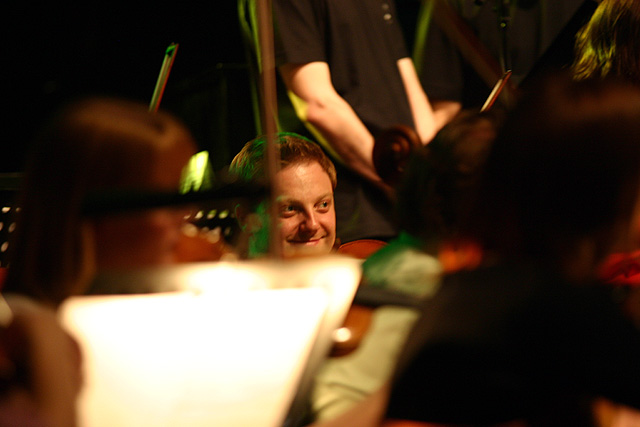
I was lucky enough to get a ticket to Thursday's dress rehearsal of Kaija Saariaho's new opera Adriana Mater at the Finnish National Opera; the official première was last night. Having followed Saariaho's music for the last thirteen years, and having attended three performances of her previous opera L'amour de loin, there was really no question as to whether I was going to like this piece or not. Saariaho's music is captivating, agonisingly beautiful, at times visceral and violent, and Adriana Mater is no exception. For those with Finnish, here is Helsingin Sanomat's review.
The intricacies and subtleties of the music and staging require too much thought to post about right now, but perhaps I'll return to this subject at a later opportunity. I'm compelled to post regarding a conversation I had last night with K, who had just come from the première. K is himself a formidable and experienced musician, whose opinions I don't take lightly. For me, this fact makes his assessment of the opera all the more alarming. I described the opera as "häkellyttävä" (astounding, astonishing), to which K replied that that would certainly be an appropriate term. After I said that I had expected nothing less from Saariaho, it turned out that his comment was meant sarcastically. "How so?" I asked. "Well, for a start, it's badly written, badly orchestrated, and the orchestra doesn't get to play any melodies," he replied. For a moment, these comments rendered me speechless. Of course, people can disagree on the merits of any given piece of music, and I love a good argument as much as anyone, but in this instance, K's argumentation is, in my opinion, so fundamentally flawed that it has driven me to afford it deeper consideration.
Admittedly, I haven't examined the score very closely but, having a knowledge Saariaho's previous music, I think it's fair to say that melody is not and has never been a defining feature of her aesthetic. According to K, the players find the piece "boring". Do they feel cheated because they don't get to play grand melodies, I wonder. Perhaps more than concert music, isn't opera all about the audience, about the experience of listening to an orchestra while being visually stimulated by what is happening on the stage? Boring or not for the musicians, Adriana Mater is a highly successful piece of music theatre precisely because it engages the audience, which for me is a more relevant criterion by which to judge the music than whether the musicians enjoy playing it or not.
When I asked K to give an example of how the piece is "badly orchestrated", he mentioned a section in the clarinet part which requires a high c#4. "How can a player be expected to produce this note night after night?" he asked. A quick look on Google reveals fingering charts for all the notes up to d4. Agreed, these pitches are at the upper reaches of the clarinet's altissimo register, but you can't call something badly written just because it's difficult. If you claim to play the clarinet, you play the whole clarinet, not just the easy bits.
Performers are notorious for taking the path of least resistance when it comes to new music. Too often one hears performers claim that certain techniques are "impossible", when what they mean is that they are difficult, outside the boundaries of standard technique (agreed), the implication being that these techniques actually involve some practice. At a new music workshop a few years ago, the cellist who played my piece came up to me later in the evening and told me that I shouldn't write microtones because they're very hard to produce. Well, cry me a river! I replied by explaining that, as a string player, I know exactly how difficult (or not) it is to produce microtones on a string instrument. To give a more extreme example: Brian Ferneyhough's music is "difficult", but if you decide to perform it you then take on the responsibility of learning it properly. That this is a revelation to some professional musicians is surprising to say the least.
This whole conversation – and writing this post – reminds me of the exchange between amputee pianist Paul Wittgenstein and Maurice Ravel regarding the latter's Piano Concerto for the Left Hand (commissioned by the former). Wittgenstein wanted to rearrange some aspects of the piano part claiming famously that "performers must not be slaves!" Ravel's answer was simple and to the point: "Performers are slaves." The day composers allow performers' whims and, dare I say, in some cases, laziness to dictate what can and can't be done with their instruments will be the day all progress in the field of musical expression grinds to a halt.
Showing posts with label Opera. Show all posts
Showing posts with label Opera. Show all posts
Sunday, February 24, 2008


Subscribe to:
Posts (Atom)